Labor and Delivery Nurse Resume: Complete Guide with Sample, Skills & RNC-OB Tips
Labor and Delivery Nurse Resume 2026: Complete Guide with Sample, Skills & RNC-OB Tips
Introduction
You can read a fetal heart strip in seconds, recognize the early signs of postpartum hemorrhage before anyone else on the unit, and hold space for a family during the most important moments of their lives. But translating that combination of clinical precision and emotional fluency onto a single page of paper? That’s a different skill, and it’s the one most L&D nurses we hear from find genuinely hard.
This guide covers what makes L&D resumes different from other nursing resumes: the certifications that actually carry weight (RNC-OB, C-EFM, NRP), how to quantify high-risk OB experience without sounding clinical-cold, fetal monitoring keywords ATS systems search for, and a complete sample resume with annotations.
If you want the broader Canadian nursing resume format guide first, see our Canadian Nursing Resume guide. This article assumes you already know the basics and focuses on what makes L&D resumes different.
Key Takeaways
- RNC-OB certification is the most valuable credential to lead with — eligibility requires 2 years and 2,000 hours of OB experience
- Quantify everything: deliveries per shift, high-risk caseload percentage, EFM hours, unit volume
- Name specific scenarios: postpartum hemorrhage, shoulder dystocia, preeclampsia, fetal distress
- EFM (Electronic Fetal Monitoring) is the keyword recruiters and ATS systems search for most
- L&D nurses bridge low-risk and high-risk care — show both ends of the range
- Emotional and family-centered care matters here more than in most specialties — but show it through specific actions, not adjectives
- For travel L&D, quantify unit volume, EHR systems used, and self-directed orientation explicitly
Why L&D Resumes Are Different
A medsurg resume and an L&D resume are scanned by recruiters for completely different things. An L&D unit manager isn’t asking “is this person a competent nurse?” — they’re asking “can this nurse identify a non-reassuring fetal heart strip in the next 30 seconds and act on it?” The skill set is unique because L&D is the rare specialty where the patient population is largely healthy until it suddenly isn’t.
This changes what goes on your resume:
- Fetal monitoring proficiency is non-negotiable. Generic phrases like “monitored patients” don’t tell recruiters anything. Specifics — Category I/II/III tracing interpretation, accelerations, late decelerations, variable decelerations, baseline variability — show competency.
- High-risk vs low-risk experience needs to be specified. “L&D experience” alone doesn’t distinguish a nurse from a Level I community hospital from a nurse at a Level IV academic perinatal center. Always name the unit’s risk level and patient population.
- Emergency response specifics matter more than in most specialties. Postpartum hemorrhage, shoulder dystocia, eclamptic seizure, cord prolapse, abruption — these are scenarios that mid-career L&D recruiters know define your readiness. Naming them shows you’ve handled them.
- Postpartum, antepartum, and triage exposure adds breadth. Many L&D RNs cross-cover all three. If you do, say so explicitly — it’s a hiring asset.
The 4 Things Every L&D Resume Must Prove in 30 Seconds
When an L&D nurse manager picks up your resume, they’re scanning for answers to four specific questions. Make these impossible to miss:
- Patient acuity range — Low-risk only, or comfortable with high-risk OB?
- Fetal monitoring competency — How fluent are you with EFM interpretation and intervention?
- Certifications validating your scope — RNC-OB, C-EFM, NRP, ACLS, STABLE
- Years of focused L&D experience — Not total nursing, but L&D specifically (and ideally noted by sub-area: labor, postpartum, triage, antepartum)
L&D Sub-Specialty Differences: What Each Unit Values
L&D isn’t monolithic. The skills that win you a job at a community hospital with 80 deliveries/month look different from what wins at a Level IV academic perinatal center with 400+ deliveries/month and a fetal surgery program. Below is a guide to what each unit type prioritizes.
Community Hospital L&D (typically Level I or II)
Most patients are low- to moderate-risk. The unit may handle vaginal deliveries, scheduled C-sections, and basic interventions, but transfers high-risk patients to a higher-level facility. What recruiters look for:
- Comfort with autonomous nursing judgment when physicians aren’t physically present
- Strong basic L&D fundamentals — labor support, EFM, epidural management, basic newborn assessment
- Cross-coverage flexibility — ability to float between L&D, postpartum, and nursery
- Emergency stabilization before transfer
- Patient and family education for low-risk discharge
Level III / Tertiary Center L&D
Higher-risk patient population, in-house OB-GYN coverage, NICU on site. What recruiters look for:
- High-risk OB experience — preeclampsia, gestational diabetes, multiples, preterm labor
- Comfort with magnesium sulfate and other high-risk medications
- Operative delivery experience — vacuum, forceps, emergency C-section circulation
- Postpartum hemorrhage protocols and massive transfusion experience
- NICU coordination for at-risk newborns
Level IV Academic Perinatal Center
Highest-risk pregnancies, MFM (Maternal-Fetal Medicine) specialty, often fetal surgery capability. What recruiters look for:
- Complex high-risk caseload — placenta accreta, severe preeclampsia, cardiac complications, fetal anomalies
- Research and EBP awareness — many academic centers expect engagement with clinical research
- Precepting and teaching — academic centers train residents and students; L&D RNs often participate
- Specialty procedure exposure — fetal monitoring during fetal surgery, ECMO-bridge OB cases
- Multidisciplinary coordination with MFM, anesthesia, neonatology, cardiology
Birth Center / Midwifery Model
Often freestanding or hospital-affiliated, low-intervention births. Recruiters look for:
- Natural childbirth support — non-pharmacological pain management, hydrotherapy, position changes
- Strong autonomous practice — minimal physician oversight
- Recognition of when to transfer — quick decision-making when low-risk becomes high-risk
- Family-centered care fluency — birth plans, doula collaboration, postpartum education
Postpartum / Mother-Baby Unit
Sometimes hired separately from L&D, often staffed by L&D-trained nurses. Recruiters look for:
- Newborn assessment — Apgar scoring, glucose monitoring, jaundice screening
- Breastfeeding support — IBCLC if certified, or coursework toward it
- Postpartum complication recognition — late hemorrhage, postpartum depression screening, mastitis
- Discharge education — newborn care, contraception counseling, warning signs
If you’ve worked in more than one of these settings, that breadth is a major asset. Make it clear in your experience section.
The L&D-Specific Resume Structure
Use this structure. The order matters — it answers the recruiter’s scan in priority order:
- Header — Name, credentials (RN, BSN, RNC-OB), location, phone, email, LinkedIn
- Professional Summary — 3–4 lines; lead with title, years in L&D, top 2–3 clinical strengths, one quantified impact
- Licensure & Certifications — RN + RNC-OB + C-EFM + NRP + ACLS
- Clinical Experience — reverse chronological, sub-specialty details
- Clinical Skills — grouped into Fetal Monitoring, Procedures, Patient Populations, EHR/Tools
- Education — BSN minimum, MSN if applicable
- Professional Development — recent OB-specific CE, AWHONN membership, precepting
Stick to 1–2 pages. Even 15-year L&D veterans should not exceed 2 pages — recruiters interpret length as a lack of focus, not abundance of experience.
How to Quantify L&D Experience (With Examples)
The difference between a forgettable L&D resume and one that lands interviews is almost always in the numbers. Below are examples drawn from real L&D role descriptions — pick the ones that fit your experience and adapt them.
Weak example:
– Cared for laboring patients
– Monitored fetal heart rates
– Worked with team
Strong example:
– Provided direct labor support for 4–6 patients per 12-hour shift in a 22-bed L&D unit averaging 180 deliveries/month, with 35% high-risk caseload
– Interpreted continuous EFM (Category I, II, III tracings) using Watson Centricity Perinatal; escalated 14 cases of non-reassuring fetal status to OB team in 2024
– Co-managed 8+ postpartum hemorrhage events using massive transfusion protocol and bimanual uterine compression with zero maternal mortality
Numbers that land for L&D roles:
- Volume: “180 deliveries/month, 22-bed unit” or “60 deliveries/month at community hospital”
- Risk profile: “35% high-risk caseload” or “Level IV perinatal center”
- Patient ratio: “1:1 active labor; 1:2 to 1:3 in postpartum”
- EFM hours: “1,500+ hours interpreting continuous EFM”
- Specific events: “managed 8+ postpartum hemorrhage events; 5+ shoulder dystocia”
- Cesarean section role: “circulated and recovered 200+ scheduled and emergency C-sections”
- Precepting: “precepted 10 new graduate L&D nurses since 2023 with 90% retention”
- Awards/recognition: “DAISY Award nominee 2024” or “AWHONN Excellence in Nursing recognition”
Fetal Monitoring and Clinical Skills Checklist
ATS systems and human recruiters both scan for specific keywords. List only what you have direct experience with — claiming familiarity with high-risk procedures you’ve only observed creates problems in interviews. Here’s a comprehensive checklist organized by category.
Fetal Monitoring (the most-searched category)
- Continuous Electronic Fetal Monitoring (EFM)
- Internal fetal scalp electrode (FSE)
- Intrauterine pressure catheter (IUPC)
- Category I, II, and III tracing interpretation per NICHD/ACOG criteria
- Recognition of accelerations, late decelerations, variable decelerations, prolonged decelerations
- Baseline variability assessment (absent, minimal, moderate, marked)
- Maternal-fetal monitoring software (Watson Centricity Perinatal, OBIX, NaviCare WatchChild, GE Centricity)
Labor Management Procedures
- IV induction with oxytocin (Pitocin) titration
- Cervical ripening with prostaglandins (Cervidil, Cytotec)
- Magnesium sulfate administration for preeclampsia or tocolysis
- Epidural assistance and post-epidural monitoring
- Foley balloon induction
- Amniotomy (AROM) assistance
- Position changes for fetal repositioning (peanut ball, side-lying, hands-knees)
Delivery Support
- Vaginal delivery assistance (spontaneous, vacuum-assisted, forceps-assisted)
- Cesarean section circulation (scheduled and emergency)
- Cesarean section recovery
- VBAC monitoring and support
- Crash C-section response
Emergency Scenarios (name what you’ve handled)
- Postpartum hemorrhage (PPH) — uterine atony, retained placenta, lacerations
- Massive transfusion protocol
- Shoulder dystocia (HELPERR mnemonic, McRoberts, suprapubic pressure)
- Eclamptic seizure management
- Cord prolapse
- Placental abruption
- Uterine rupture recognition
- Amniotic fluid embolism response
Newborn Care (immediately post-delivery)
- Neonatal Resuscitation Program (NRP) protocols
- Apgar scoring
- Initial newborn assessment, including weight, length, vital signs
- Skin-to-skin and breastfeeding initiation
- Glucose monitoring for at-risk newborns
- Recognition of respiratory distress, hypoglycemia, hypothermia
Antepartum / Triage
- Triage assessment of laboring vs. non-laboring patients
- Non-stress test (NST) and biophysical profile (BPP) assistance
- Antepartum testing for high-risk pregnancies
- Patient education on signs of preterm labor, preeclampsia warning signs
The honest reality: listing skills you haven’t actually performed is a common pattern, and interview questions quickly expose it. Stick to what you can speak to in detail.
How to Position RNC-OB on Your Resume
RNC-OB (Registered Nurse Certified – Inpatient Obstetric Nursing) is the gold-standard certification for L&D nursing. If you have it, lead with it. If you don’t, you’re competing at a disadvantage in many markets — especially at academic centers and Level III/IV hospitals.
If you have RNC-OB:
Put it directly after your name in the header. Example:
SARAH MARTINEZ, BSN, RN, RNC-OB
Then list it in the Certifications section with renewal status:
CERTIFICATIONS
• Inpatient Obstetric Nursing (RNC-OB) — NCC | Current (Exp. 2027)
• Electronic Fetal Monitoring (C-EFM) — NCC | Current
• Neonatal Resuscitation Program (NRP) — Current (Exp. 2026)
• Advanced Cardiovascular Life Support (ACLS) — Current
• Basic Life Support (BLS) — Current
If you’re working toward RNC-OB:
The eligibility threshold is real — you need 2 years and 2,000 hours of OB-specific experience before you can sit the exam. If you’re not yet eligible, that’s fine; just don’t claim certification you don’t have. Once eligible, state your exam date:
CERTIFICATIONS
• RNC-OB — Eligibility met; exam scheduled August 2026
If you have C-EFM but not RNC-OB:
C-EFM is a strong standalone certification, especially if you work in triage or high-risk antepartum where fetal monitoring is the primary clinical task. Lead with it confidently:
CERTIFICATIONS
• Electronic Fetal Monitoring (C-EFM) — NCC | Current (Exp. 2027)
• RNC-OB — Eligibility met (2,400+ OB hours); planning Q3 2026 exam
Other Valuable L&D Certifications
- NRP (Neonatal Resuscitation Program) — usually required, not optional
- STABLE — post-resuscitation newborn stabilization, valuable in community hospitals without on-site NICU
- IBCLC (International Board Certified Lactation Consultant) — major differentiator for postpartum/mother-baby roles
- RNC-MNN (Maternal Newborn Nursing) — for postpartum/mother-baby focused roles
- AWHONN Intermediate or Advanced Fetal Heart Monitoring — strong in lieu of or alongside C-EFM
- ACLS — increasingly required even in low-risk units
- TNCC — useful for trauma OB scenarios
Sample Labor and Delivery Nurse Resume
A complete sample for an L&D nurse with 5 years of experience applying to a Level III perinatal center. Adapt the specifics to your situation.
─────────────────────────────────────────────────
SARAH MARTINEZ, BSN, RN, RNC-OB
Toronto, ON | (123) 456-7890 | sarah.martinez@email.com
LinkedIn: linkedin.com/in/sarahmartinezrn
─────────────────────────────────────────────────

PROFESSIONAL SUMMARY
RNC-OB certified Labor and Delivery RN with 5+ years of progressive
experience across Level II and Level III perinatal centers. Proficient
in continuous EFM interpretation, high-risk OB management, and
emergency response including postpartum hemorrhage and shoulder
dystocia. Seeking to transition to Level IV academic perinatal
center to support complex MFM caseload.

LICENSURE & CERTIFICATIONS
• Registered Nurse — College of Nurses of Ontario (CNO)
  License #RN234567 | Active | Expires March 31, 2027
• NCLEX-RN — Passed June 2020
• Inpatient Obstetric Nursing (RNC-OB) — NCC | Current (Exp. 2027)
• Electronic Fetal Monitoring (C-EFM) — NCC | Current (Exp. 2027)
• Neonatal Resuscitation Program (NRP) — Current
• Advanced Cardiovascular Life Support (ACLS) — Current
• Basic Life Support (BLS) — Current
• AWHONN Intermediate Fetal Heart Monitoring — Completed 2024

CLINICAL EXPERIENCE

Registered Nurse — Labor and Delivery
Mount Sinai Hospital, Toronto | March 2022 – Present
• Provide direct labor support for 4–6 patients per 12-hour shift in
  a 28-bed Level III L&D unit averaging 320 deliveries/month with
  45% high-risk caseload (preeclampsia, gestational diabetes,
  multiples, preterm labor)
• Interpret continuous EFM (Category I, II, III tracings) using
  Watson Centricity Perinatal; escalated 22 non-reassuring tracings
  to OB team in 2024 with no adverse outcomes
• Co-managed 12+ postpartum hemorrhage events using massive
  transfusion protocol and bimanual uterine compression
• Circulated and recovered 180+ cesarean sections (scheduled and
  emergency); served as primary nurse for 8 emergency crash C-sections
• Administered magnesium sulfate, oxytocin, and Cervidil per
  protocols with zero documented medication errors over 36 months
• Precepted 6 new graduate L&D nurses since 2023; 100% completed
  orientation and remain on the unit
• Active member, hospital Postpartum Hemorrhage Quality Improvement
  Committee (2024–present)

Registered Nurse — Labor, Delivery, Recovery & Postpartum (LDRP)
Trillium Health Partners, Mississauga | August 2020 – February 2022
• Provided full-spectrum LDRP care in a 14-bed community hospital
  unit averaging 90 deliveries/month
• Cross-covered triage, active labor, recovery, and postpartum
  with 1:1 to 1:3 ratios
• Performed newborn assessments, initial Apgar scoring, glucose
  monitoring, and breastfeeding initiation support
• Educated patients and families on labor progression, pain
  management options, and postpartum self-care
• Recognized 4 cases of severe preeclampsia at triage requiring
  immediate intervention and transfer to higher-acuity care

CLINICAL SKILLS

Fetal Monitoring:
Continuous EFM | Internal Fetal Scalp Electrode | IUPC |
Category I/II/III interpretation (NICHD/ACOG) | NST | BPP |
Watson Centricity Perinatal | OBIX

Labor & Delivery Procedures:
Oxytocin Induction | Cervidil/Cytotec Cervical Ripening |
Magnesium Sulfate Administration | Epidural Support |
Foley Balloon Induction | AROM Assistance |
Vaginal Delivery Support | Vacuum-Assisted Delivery |
C-Section Circulation & Recovery | VBAC Support

Emergency Scenarios (Direct Experience):
Postpartum Hemorrhage | Shoulder Dystocia (McRoberts/HELPERR) |
Eclamptic Seizure Management | Cord Prolapse | Placental Abruption |
Crash C-Section Response | Massive Transfusion Protocol

Newborn & Postpartum:
NRP Protocols | Apgar Scoring | Skin-to-Skin Initiation |
Breastfeeding Support | Newborn Glucose Monitoring |
Postpartum Hemorrhage Recognition | Postpartum Depression Screening

EDUCATION
Bachelor of Science in Nursing (BScN)
University of Toronto, Toronto, ON | 2016 – 2020
• GPA: 3.7/4.0
• Senior Practicum: 240 hours in Labor and Delivery at Mount Sinai

PROFESSIONAL DEVELOPMENT
• AWHONN Convention 2024 — Postpartum Hemorrhage Prevention Track
• Member, Association of Women's Health, Obstetric and Neonatal
  Nurses (AWHONN), Canadian Chapter
• Hospital Postpartum Hemorrhage QI Committee Member (2024–Present)
• Maternal Mental Health Workshop (2023)
─────────────────────────────────────────────────
Why This Resume Works — 6 Key Decisions
RNC-OB is visible in the header. Recruiters at Level III/IV centers scan for RNC-OB in the first second. Leading with it filters Sarah into the “qualified” pile immediately.
Unit type and volume are quantified everywhere. “28-bed Level III L&D, 320 deliveries/month, 45% high-risk” tells a Level IV recruiter exactly what level of complexity Sarah handles. Generic phrases don’t.
Specific emergencies are named, not implied. “Co-managed 12+ postpartum hemorrhage events” is verifiable and specific. “Handled emergencies” would read as filler.
Quality improvement work appears as a regular activity. The PPH committee membership signals leadership readiness without needing a separate “Leadership” section — relevant for Level IV positions where engagement with QI is expected.
The career progression is visible and intentional. Moving from a 90-delivery/month community hospital to a 320-delivery/month Level III shows graduated complexity, which is exactly what Level IV centers want to see.
EHR systems are named specifically. “Watson Centricity Perinatal” matches actual job descriptions verbatim, which helps both ATS parsing and human recruiter recognition.
6 Common Mistakes on L&D Resumes
Most of these are fixable in 10 minutes — but they’re the difference between a resume that passes ATS and one that quietly disappears.
1. Leading with “compassionate care” without evidence. Every L&D nurse claims this. Replace it with a specific moment or metric: “Supported 6 grieving families through pregnancy loss in 2024 using bereavement protocols and certified perinatal loss training.”
2. Skipping the unit’s volume and risk level. “Worked in L&D for 5 years” is weak. “Worked in 28-bed Level III L&D averaging 320 deliveries/month, 45% high-risk caseload” gives recruiters scope and complexity in one line.
3. Listing every L&D skill without evidence of frequency. Recruiters and interviewers can tell. Stick to skills you’ve genuinely performed and can speak to in detail.
4. Missing RNC-OB status entirely (when eligible). If you’ve passed the 2-year/2,000-hour threshold and aren’t pursuing RNC-OB, recruiters notice. Either pursue it or address why not in your cover letter.
5. Over-emphasizing soft skills at the expense of clinical specifics. L&D resumes often lean too far into emotional language (“compassionate,” “patient-centered,” “advocate”). These belong, but they need to be backed by specific scenarios and quantified clinical actions.
6. Hiding LDRP / cross-coverage experience. If you’ve worked in a labor-delivery-recovery-postpartum (LDRP) model or have postpartum/triage cross-coverage, that’s an asset. Many resumes downplay it as “general L&D” — name the breadth explicitly.
FAQ
Q1: How long should an L&D nurse resume be?
One page for 1–3 years of L&D experience, two pages maximum for 4+ years or leadership roles. Never exceed two — recruiters interpret length as lack of focus.
Q2: Do I need RNC-OB before applying to high-risk L&D positions?
Strongly preferred for Level III and Level IV centers. Many academic perinatal centers expect RNC-OB or require it within 12–24 months of hire. If you’ve met the 2-year/2,000-hour eligibility but haven’t sat the exam yet, state that openly with a planned exam date. New L&D nurses (first 2 years) aren’t expected to have it.
Q3: How do I handle a gap in L&D experience (e.g., switched to medsurg for 2 years)?
Be direct about it in your summary. Example: “Returning to L&D after 2 years in medsurg (parental leave); maintaining RNC-OB through CE and completing C-EFM refresher.” Hiding gaps creates distrust; owning them signals professional maturity.
Q4: I work in postpartum/mother-baby, not active L&D. Is this the right resume guide for me?
Mostly yes, with adjustments. Postpartum-focused resumes should lead with RNC-MNN (Maternal Newborn Nursing certification) instead of RNC-OB if applicable, emphasize newborn assessment and breastfeeding support, and quantify discharge education volume. Many of the high-risk OB scenarios in this guide may not apply, but EFM, NRP, and basic L&D fundamentals still matter for cross-coverage.
Q5: How do I transition from postpartum to active L&D on paper?
Highlight any moments that resembled L&D work: “Performed newborn resuscitation under NRP protocols 8 times during postpartum admissions”; “Cross-covered LDRP triage during high-volume periods, performing initial assessments on 100+ laboring patients.” Also note any L&D shadowing, NRP/AWHONN coursework, or upcoming RNC-OB plans.
Q6: Should I include personal birth experiences (my own children, doula work) on my resume?
Generally no. Personal birth experiences are not professional clinical experience and listing them can read as unprofessional. Doula work is a gray area: if you were paid as a certified doula and performed labor support in a clinical or birth-center context, you can list it as relevant volunteer or paraprofessional experience, framed clinically. Otherwise, leave it off.
Q7: Do L&D travel nurses need a different resume?
Mostly the same, with extra emphasis on adaptability and self-directed orientation. Specifically: list every L&D unit type you’ve worked in (Level I through IV, LDRP, freestanding birth center), every EHR system, and explicitly mention “self-directed orientation” or “completed 2-day orientation with immediate full-patient assignment.” Travel L&D recruiters want to see you can land and function fast.
Tools and Resources to Build Your L&D Resume
You now have the structure, the keywords, and the sample. The question is: do you write it yourself, use a builder, or hire a writer?
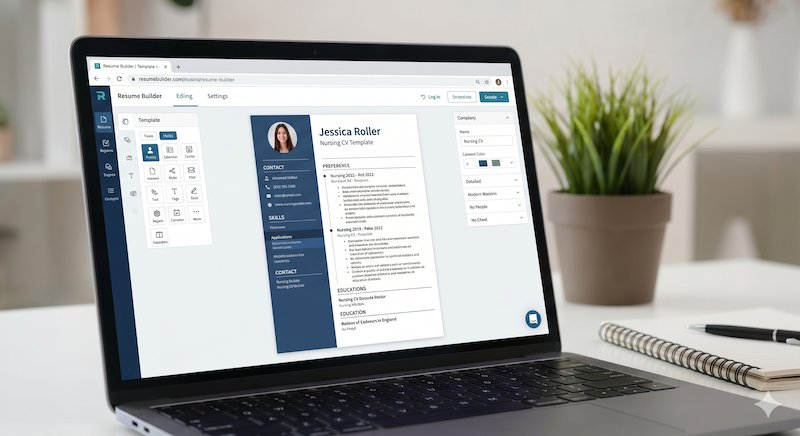
For most L&D nurses, a resume builder is the most efficient choice — handling ATS-friendly formatting automatically and letting you create tailored versions for community hospital vs. academic center applications in minutes.
Top 4 Resume Builders for L&D Nurses
1. Resume.io — Best overall. Clean ATS-safe templates, easy section reordering for placing RNC-OB and licensure near the top. Trial $2.95 then $24.95/month — set a calendar reminder if you only need it once.
2. Yotru — Best for emotional nuance. AI tone adjustment helps when describing perinatal loss, family-centered care, or high-stakes scenarios without sounding clinical-cold. Free PDF export available.
3. Kickresume — Best free option. Real downloadable PDFs (with small watermark on free tier). Good fit for new L&D grads testing the market before paying.
4. Enhancv — Best for leadership and academic roles. Distinctive design that stands out to human reviewers — useful for Charge Nurse, Clinical Educator, or Level IV academic applications. $19.99/month, no aggressive trial pricing.
For full comparisons, screenshots, and pricing details, see our Best Resume Builders for Nurses guide.
When to Consider a Writing Service Instead
For nurses applying to leadership or highly specialized OB roles (Director of Women’s Services, MFM coordinator, OB Quality leader), a professional writing service with nursing specialization may be worth the investment. See our Best Resume Writing Services for Nurses for honest comparisons.
If you’re transitioning between L&D and another high-acuity specialty, our ICU Nurse Resume guide covers parallel positioning strategy. For Canadian-specific formatting, pair this guide with our Canadian Nursing Resume guide.
L&D work is some of the most emotionally demanding nursing in the world — you hold space for both the highest highs and some of the hardest moments people will ever experience. Writing a resume that reflects it is, comparatively, the smaller problem — and one worth solving properly, because a good L&D resume doesn’t just get interviews. It quietly tells hiring managers that you bring the same precision and presence to the page that you bring to the bedside.
Good luck with your search.